Introduction
‘Dark patterns’ are deceptive design tactics used by online platforms that are often unnoticeable to users while subtly misleading or tricking them into actions they did not intend to take. Increasingly embedded in the design of many digital platforms, these practices have become a common feature of the online user experience. By impairing consumer autonomy and decision-making, these practices raise significant concerns under India’s consumer protection framework. Some common examples of dark patterns include:
-
Hidden fees that are not clearly disclosed at the point of payment;
-
Default add-ons automatically included in purchases;
-
False urgency cues, such as countdown timers or limited availability notifications, that create pressure on consumers to act quickly.
The deployment of such dark patterns is a contravention of Indian consumer protection law, or specifically, the Guidelines for Prevention and Regulation of Dark Patterns, 2023, (“Dark Patterns Guidelines”). E-commerce and other digital platforms are now under heightened scrutiny from the Department of Consumer Affairs and the Central Consumer Protection Authority (“CCPA”), as the regulator moves to curb dark patterns that distort or influence consumer choice.1 Recent enforcement actions, including fines imposed on entities dealing with aviation,2 e-commerce3 and digital healthcare,4 as well as the fine of INR 7,00,000 on a prominent quick commerce platform for indulging in dark patterns by imposing hidden fees and default add-on-s onto its users5 underscore the increasing regulatory focus on dark patterns in digital commerce.
Regulatory Framework Governing Dark Patterns in India
In India, dark patterns are regulated through a dual framework, comprising statutory regulation under the Consumer Protection Act, 2019 (“CPA”) and industry self-regulation by the Advertising Standards Council of India (“ASCI”).
Regulation under the CPA
The CPA, the Dark Patterns Guidelines, and the Consumer Protection (E-Commerce) Rules, 2020 (“E-Commerce Rules”) issued under the CPA together form a unified regulatory mechanism to address and curb dark patterns.
Dark Patterns Guidelines
The CCPA6 has issued the Dark Patterns Guidelines, which define dark patterns as “…any practices or deceptive design pattern using user interface or user experience interactions on any platform that is designed to mislead or trick users to do something they originally did not intend or want to do, by subverting or impairing the consumer autonomy, decision making or choice...”.7
The Dark Patterns Guidelines apply to: (i) all platforms8 systemically offering goods and services in India; (ii) advertisers9; and (iii) sellers10, and state that engaging in dark patterns may amount to unfair trade practices (“UTPs”),11 misleading advertisements,12 or a violation of consumer rights,13 which are prohibited under the CPA.14
The Dark Patterns Guidelines thus provide the CCPA15 and the Consumer Dispute Resolution Commissions (“CDRCs”)16 with direct authority to act against dark patterns. While the CDRCs adjudicate complaints relating to specific goods or services sold or agreed to be sold,17 the CCPA has a broader mandate to address violations of consumer rights, including unfair trade practices and misleading advertisements, and may act suo motu or on the basis of a complaint forwarded to it.18
E-Commerce Rules
Additionally, the E-Commerce Rules apply to all forms of e-commerce19 and all e-commerce entities20 offering goods or services to consumers in India and prohibit e-commerce entities, including marketplace e-commerce entities,21 sellers on such platforms, and inventory e-commerce entities,22 from engaging in UTPs23 and require transparency in pricing and consent mechanisms in a manner aligned with the Dark Patterns Guidelines.24 Thus, an e-commerce entity or a seller on such platforms deploying dark patterns may additionally be liable for a violation of the E-Commerce Rules, which is punishable under the CPA.25
Regulation through ASCI
ASCI’s Code for Self-Regulation of Advertising Content in India (“ASCI Code”) prohibits misleading, exaggerated, or unfair representations, including those that arise from deceptive designs / dark patterns.26 The ASCI code specifically includes ‘Guidelines for Online Deceptive Design Patterns in Advertising’ (“ASCI’s Dark Patterns Guidelines”)aimed at addressing dark patterns.27
Complaints relating to advertisements are reviewed by the Consumer Complaints Council (“CCC”), which assesses whether an advertisement contravenes the ASCI Code and recommends corrective action where required.28 While ASCI’s decisions are not legally binding, in cases of non-compliance with the CCC’s recommendations, ASCI escalates the matter to the relevant regulatory authority, such as the CCPA, which may initiate action under applicable law.29
Types of Dark Patterns
The Dark Patterns Guidelines issued by the CCPAidentify 13 dark patterns, which are as follows:
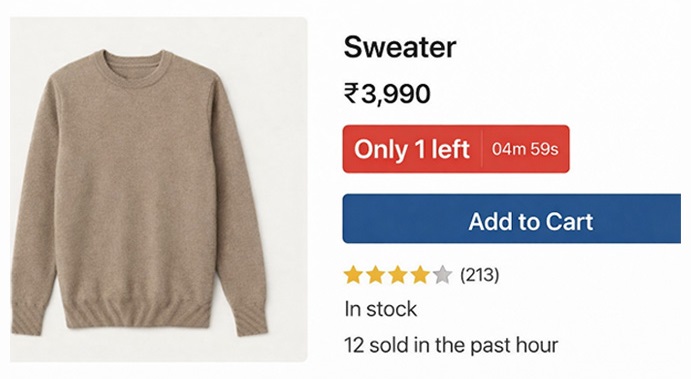
False Urgency
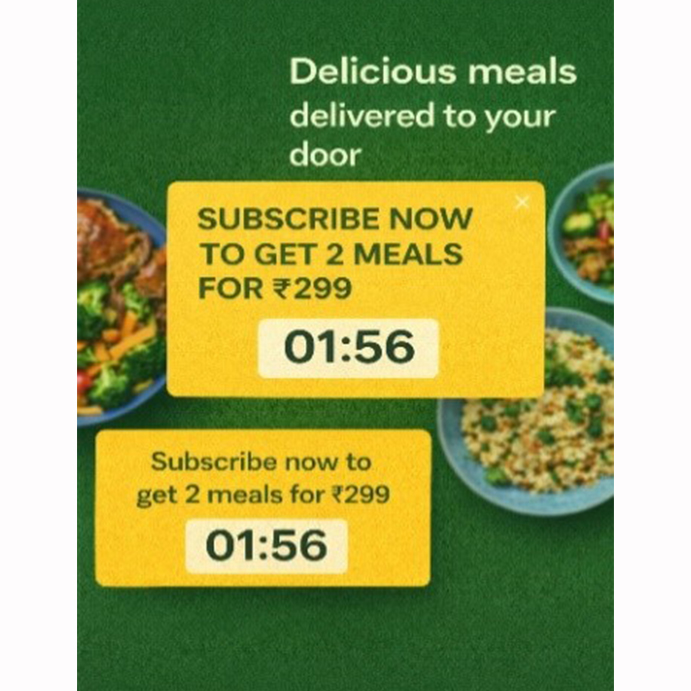
This dark pattern creates a false impression of urgency or scarcity of goods or services to pressure users into making quick decisions. It misleads consumers by overstating demand or falsely indicating limited stock or duration of offers.30
For instance: an online store may display a countdown timer such as “Flash sale ends in 10 minutes,” but the timer resets each time the page is refreshed, giving a false sense of urgency.
Basket Sneaking
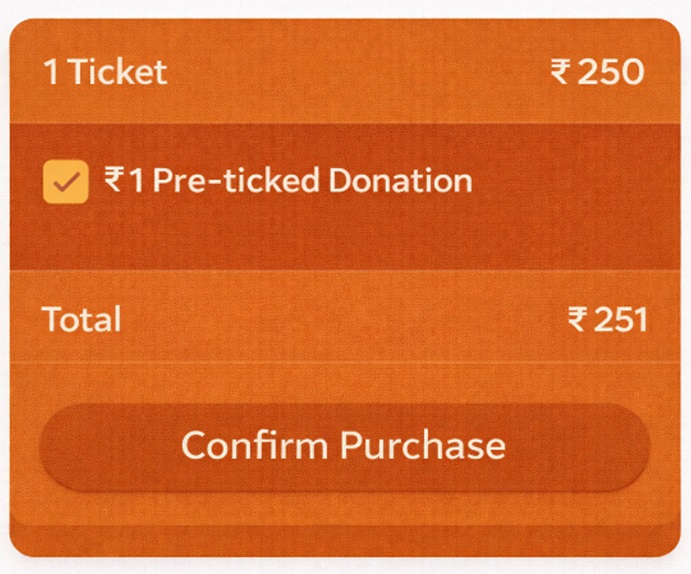
Basket sneaking is when extra products, services, or charges are added to a user’s cart without their consent, increasing the total amount they have to pay. Only necessary and clearly disclosed fees, such as taxes, delivery charges, or complimentary items, are excluded.31
For instance: an online store might automatically add an extended warranty or donation to the cart, requiring users to manually remove it before checkout. Recently, the CCPA issued a notice to a booking platform after finding that it automatically added ₹1 per ticket towards its charity initiative without consumer consent, following which the platform revised its interface to provide a clear opt-in for such donations.32
Confirm Shaming
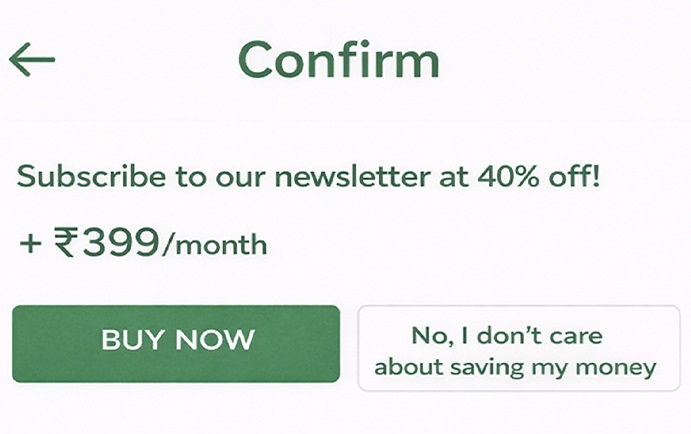
Confirm shaming uses language or other means of creating guilt, ridicule, fear or shame to nudge users into making a purchase or continuing a service, primarily for the purpose of making commercial gains by subverting consumer choice.33
For instance: A pop-up on a website that says, “No, I don’t care about saving my money,” when a user declines a discount or newsletter offer. Recently, the CCPA issued a notice to an airline company for ‘confirm shaming’ by requiring consumers opting out of travel assistance (such as baggage insurance) to click on a button that read, “No, I will take risk”.34 Following the notice, the airline revised its app and website to use neutral language (“No, I will not add to the trip”).
Forced Action
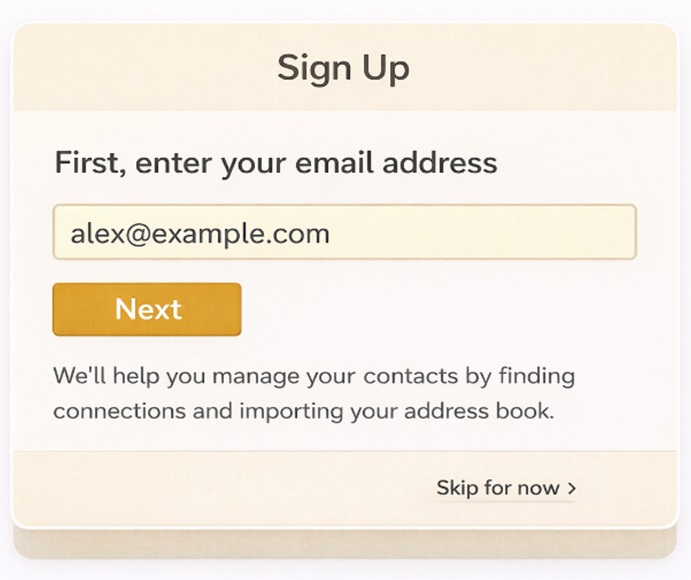
Forced action means forcing users to take unrelated or unnecessary actions, such as sharing personal information, subscribing to an unrelated service etc, just to complete their intended transaction.35
For instance: consider a user who downloads a basic photo-editing application with the sole intention of performing a simple task such as cropping an image. Upon opening the application, the user is unable to access any features unless they first create an account, grant access to their contact list, and consent to receiving marketing communications. These requirements are not necessary for the core functionality of the service and are imposed as a condition precedent to its use, thereby compelling the user to undertake unrelated actions.
Subscription Trap
A subscription trap makes cancellation of paid subscriptions difficult, by hiding the cancellation options, making the instructions for cancellation confusing, etc. It can also include requiring a user to provide payment details or authorization for automatic debits for availing a free subscription that may result in unintended ongoing payments.36
For instance: A streaming platform employs a restrictive cancellation policy. Users are not provided with any in-platform option to cancel their subscription through their account dashboard. Instead, cancellation is deliberately routed through a customer support helpline with limited operating hours, creating delay and inconvenience for the customer. This design increases the likelihood of continued billing and makes it more difficult for users to cancel than to subscribe.

Interface Interference
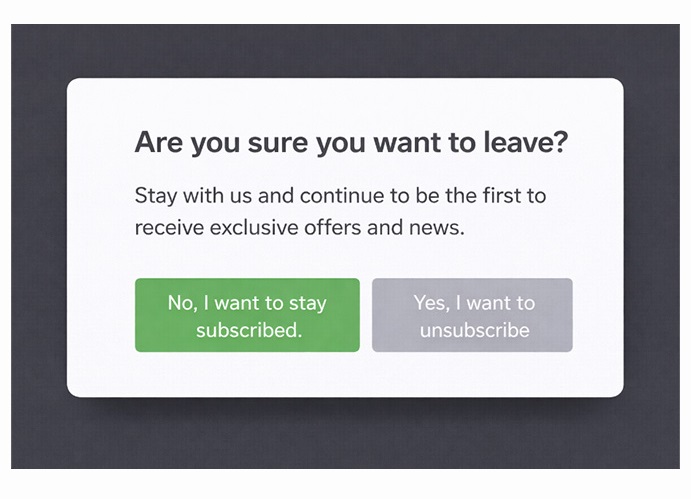
This involves manipulating the design elements to highlight certain options while obscuring others, misdirecting users from taking actions towards their desired choices. It can include misleading buttons, deceptive symbols or visuals, or confusing placement of options.37
For instance: A website may show a large, bright “Accept All” button for favourable actions such as staying subscribed, accepting cookies etc., while hiding the “Reject” option in a small grey link at the bottom of the page.
Bait and Switch
‘Bait and switch’ refer to luring consumers with a promised offer or product, only to present them with an inferior or more expensive alternative.38
For instance: An online store might advertise an item for sale, but when the user clicks “Buy,” only higher-priced versions are shown as available.

Drip Pricing
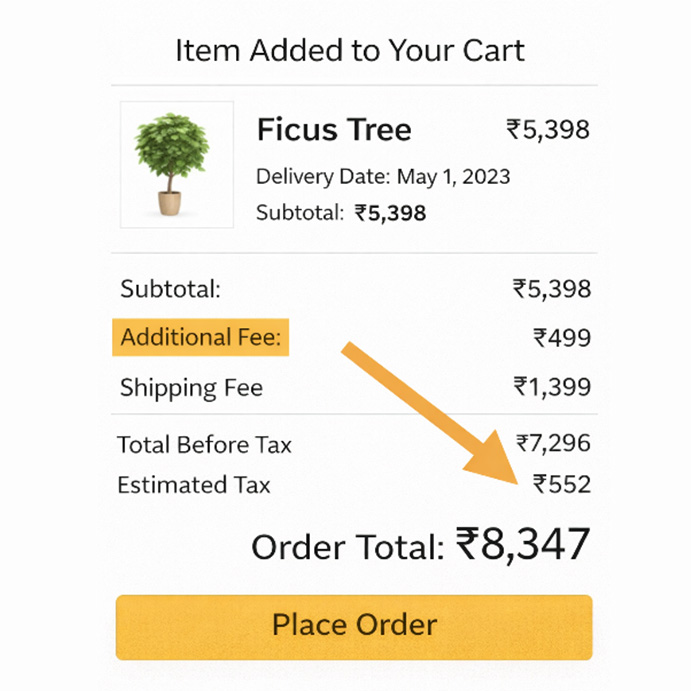
Drip pricing hides parts of the total or actual cost of a product or service until later stages of checkout, resulting in a higher final price than initially displayed. It also includes falsely advertising products as “free” while concealing mandatory paid components.39
For instance: For instance, downloading a movie or music app because it’s advertised as “free”. However, upon opening the app, you find that you cannot access any content unless you first purchase a subscription. Since this requirement was not disclosed before downloading the app, the user either has to pay the subscription fee or not use the app at all.

Other examples include websites that reveal previously undisclosed ‘additional fees’ of various kinds which weren’t disclosed to the users previously but are only added once the user reaches the checkout page.
Disguised Advertisement
Disguised advertising masks promotional content as neutral or user-generated material meant to blend in with the rest of the interface, tricking users into engaging with advertisements unknowingly.40
For instance: A ‘news article’ on a website may be a paid product promotion that has not been labelled as “sponsored.”

Nagging
Nagging disrupts user experience by repeatedly showing pop-ups, prompts, or interruptions that push users towards making a transaction resulting in commercial gains, unless specifically permitted by the user.41
For instance: An app may keep showing pop-ups to subscribe, upgrade to premium or enable notifications, despite the user declining multiple times.
Trick Questions
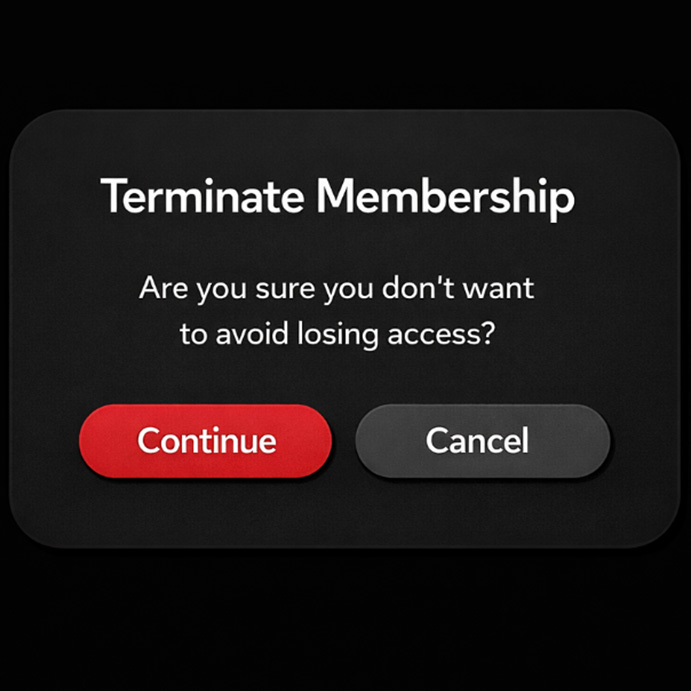
Trick questions deliberately use confusing or misleading language, such as double negatives or unclear phrasing, to manipulate user responses.42 It may lead users to inadvertently agree to something they might otherwise decline.
For instance: A dialogue box for cancelling a membership that asks a convoluted question in order to make it difficult for a user to select their desired action. A subscription service presents the following message when a user attempts to cancel: “Please confirm that you do not wish to avoid losing access to your premium membership. If you select ‘No,’ your subscription will remain active, and billing will continue. Selecting ‘Yes’ will proceed with cancellation and terminate your benefits.”
SaaS Billing
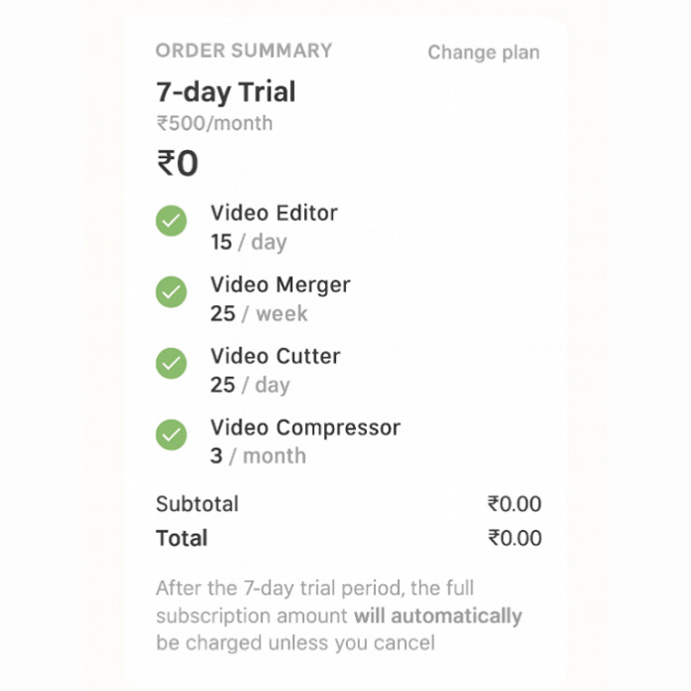
SaaS billing dark patterns use numerous deceptive practices or representations to generate and collect recurring payments from consumers in a Software as a Service (“SaaS”) business model, such as by omitting notifications of conversion of free trials to paid subscriptions, silently charging users, or using shady credit card authorization practices.43
For instance: An editing tool automatically charges users after a free-trial ends without sending any reminder or showing clear cancellation options.
Rogue Malware
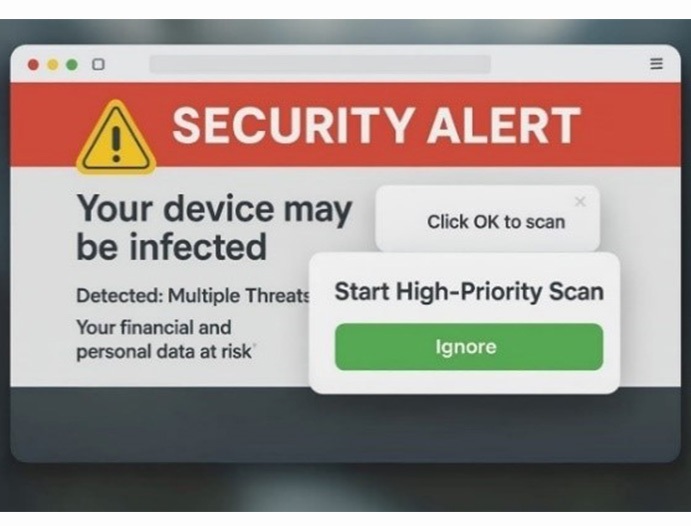
Rogue malware means using ransomware or scareware to mislead or trick users into believing there is a virus on their computer, and aims to convince them to pay for a fake malware removal tool that actually installs malware on their computer.44
For instance: A pop-up might read “Your device is infected” and prompt users to click on the option to pay for and start safety scans and then install malware on their computer.
Regulatory Enforcement and Recent Actions
Directives Issued by the CCPA
In June 2025, the CCPA issued an advisory, advising e-commerce platforms to conduct a self-audit of their interfaces and business practices to identify and remove dark patterns.45 Platforms were required to complete this review within three months and make self-declarations confirming compliance.
Several entities have conducted self-audits and made self-declarations in accordance with the advisory.46
Orders by CCPA and CDRCs
The CCPA may, upon receiving a complaint, information, directions from the Central Government, or on its own, carry out a preliminary review to assess whether there are sufficient grounds to suggest a possible violation of the CPA. If such grounds are found, it may initiate a formal investigation.47
Following the investigation, if the CCPA concludes that there is sufficient evidence of a dark pattern, the conduct may be treated under the CPA as a misleading advertisement, an unfair trade practice, or a violation of consumer rights. Any action or remedies will then be based on the relevant provisions of the CPA governing such conduct.
Orders by the CCPA in case of Misleading Advertisements48
Where a case of misleading advertisement is adjudicated by the CCPA, it may issue directions to the concerned trader,49 manufacturer,50 endorser,51 or advertiser52, including orders to discontinue or modify misleading advertisements. Additionally, the CCPA may, at its discretion, impose a penalty which may extend up to INR 10,00,000 on a manufacturer or endorser, (and a penalty for every subsequent contravention which may extend up to INR 50,00,000.53
The CPA also provides that if a manufacturer or service provider issues a false or misleading advertisement that harms consumers, they may face penalties including imprisonment for up to two years and a fine of up to INR 10,00,000. For repeat offences, the penalties increase to imprisonment for up to five years and a fine of up to INR 50,00,000. 54
Orders by the CCPA in case of UTPs and Violations of Consumer Rights55
Where the CCPA is satisfied that a person has engaged in UTPs or violated consumer rights, the CPA provides that the CCPA may pass ‘any such orders as may be necessary’, including those directing: (i) the discontinuation of practices which are unfair and prejudicial to consumer’ interest; (ii) the reimbursement of the prices of goods or services recalled to purchasers of such goods or services; and (iii) the recalling of goods or withdrawal of services which are dangerous, hazardous or unsafe.56 Unlike the provisions on the CCPA’s powers in case of false and misleading advertisements mentioned above, the CPA does not explicitly empower the CCPA to impose penalties or imprisonment for UTPs or violations of consumer rights. The CCPA's powers here are framed more broadly — it may pass "any such orders as may be necessary" — which, while potentially wide in scope, leaves the extent of its powers open to debate.
[While the CPA does not explicitly provide for the imposition of penalties by the CCPA for UTPs or consumer rights violations, the CCPA has, in practice, relied on its power to issue directions and levy penalties in cases of misleading advertisements, together with its broad power to pass "any order as may be necessary" in cases of UTPs and consumer rights violations, to levy penalties even in cases of dark patterns which may be has categorized as UTPs or consumer rights violations, but not misleading advertisements.
Additionally, although the CPA's penalty provisions for misleading advertisements are worded to apply only to manufacturers or endorsers, the CCPA has in practice extended penalties to service providers as well, even though they may not strictly fall within the scope of the provision.57]
Non-Compliance with the CCPA’s Orders / Directions
Where a concerned party fails to comply with the CCPA’s orders / directions in case of misleading advertisements, UTPs, or a violation of consumer rights, the CCPA may punish such parties with imprisonment for a term which may extend to six months or with fine which extend up to INR 20,00,000, or with both.58
Orders by State, District, and National CDRCs
If a complaint is taken up by a District CDRC (where the value of consideration for goods or services / alleged unfair contract is below INR 1,00,00,000), State CDRC(where the value of consideration for goods or services / alleged unfair contract is more than INR 1,00,00,000 but less than INR 10,00,00,000), or National CDRC (where the value of consideration for goods or services / alleged unfair contract is more than INR 10,00,00,000), the CDRCs may pass orders or issue directions such as refund, compensation, or discontinuance of the unfair trade practice.59
Recommendations by the CCC of ASCI
Separately, the ASCI,under its self-regulatory framework, may issue directions to withdraw or modify the offending parts of the advertising material that violate its Code or specifically, ASCI’s Dark Patterns Guidelines.60
Recent Enforcement Actions
Earlier this year, the CCPA issued notices to eleven digital platforms61 and has issued orders against entities found to be engaging in dark patterns, which included directions to discontinue the adoption of the contravening dark patterns / unfair trade practices and the levy of penalties.62
The ASCI has also been active in addressing dark-pattern-style advertising. In 2025, it updated the ASCI code to mandate clear labelling of sponsored content on social media by media companies.63
Cautionary Guidance for Retail Models
With the CCPA intensifying scrutiny of digital commerce practices, it is essential for platforms to undertake the recommended self-audits, eliminating flagged dark patterns (if any), and adopting a structured compliance framework for future monitoring. In light of the evolving regulatory landscape, digital platforms that implement a robust, forward-looking approach to compliance will be better positioned to navigate potential enforcement actions and safeguard their operations.
Some important considerations for e-commerce entities employing various kinds of retail models in digitally offering their products and services are set out below.
-
Transactional (one-time purchase) models: Platforms should ensure transparent pricing and avoid tactics like drip pricing or false urgency during checkout. Clear disclosure of all costs, delivery charges, and stock availability is essential to prevent misleading consumers.
-
Subscription-based models: Businesses should provide upfront information on renewal terms and make cancellation simple and accessible. They must endeavour to avoid subscription traps or forced auto-debits that can result in unintended payments by consumers.
-
Freemium models: Free-to-paid upgrades must be clearly distinguished, with no hidden or ambiguous terms. Users should be informed when features or benefits end and when payment will be required.
-
Advertising-driven models: Platforms relying on advertising should clearly label sponsored or paid content and avoid disguised advertisements. Such platforms must also ensure the advertisements displayed do not nag consumers or force them to take actions against their interests as consumers.
-
Hybrid / bundled retail models: Where multiple services are offered together, consumers must have clear visibility into what is bundled into an offering and the costs of each component. Platforms must avoid forced enrolments or default add-ons in a manner that could be considered basket sneaking or forced action.
Considering the significant monetary and reputational risks arising from enforcement actions and hefty penalties that may arise from violations of the Dark Patterns Guidelines, entities to whom they are applicable (i.e., platforms offering goods and services in India, advertisers and sellers) should proactively audit their platforms and practices.
Sanjana Shrivastav, Uttara Jhaveri and Aaron Kamath
You can direct your queries or comments to the authors.
1Economic Times, Action will be taken against e-commerce entities using dark patterns: Consumer Affairs Secy, available at: https://economictimes.indiatimes.com/industry/services/retail/action-will-be-taken-against-e-commerce-entities-using-dark-patterns-consumer-affairs-secy/articleshow/123923519.cms?utm_source=contentofinterest&utm_medium=text&utm_campaign=cppst (Last accessed on 10th October, 2025).
2CCPA, In the Matter of: Suo Moto case against InterGlobe Aviation Ltd. (herewith also referred as IndiGo Airlines), Ref No. CCPA-2/10/2024-ССРА (Available at: https://doca.gov.in/ccpa/checkuploaddocs.php?updocs=.%2Fuploads%2F1729844650-1718860439-CCPA+IndiGo+order+dated+19.06.2024.pdf&unique_id=&ref=static.internetfreedom.in).
3CCPA, In the Matter of: Case against Digital Age Retail Pvt. Ltd. (FirstCry), Ref No. CCPA/26/2024-ССРА, available at:
https://doca.gov.in/ccpa/checkuploaddocs.php?updocs=./uploads/1759733477-CCPAs_Final_Order_FirstCry.pdf&unique_id=.
4CCPA, In the Matter of: Case against Axelia Solutions Pvt. Ltd. (PharmEasy), Ref No.: ССРА-2/20/2024-ССРА, available at:
https://images.assettype.com/barandbench/2025-11-21/wsruyah2/CCPA_Pharmeasy_.pdf.
5 CCPA, In the Matter of: Case against Zepto Marketplace Pvt. Ltd., Case No: Z-10/1/2025-O/0 US(CCPA), available at: https://doca.gov.in/ccpa/checkuploaddocs.php?updocs=./uploads/1766468507-Zepto_Final_order__1___1_.pdf&unique_id=.
6Section 18(2)(l) empowers the CCPA to issue necessary guidelines to prevent unfair trade practices and protect consumers' interest.
7Section 2(1)(e), Dark Patterns Guidelines.
8Section 2(1)(g) of the Dark Patterns Guidelines state that the term ‘platform’ under the Dark Patterns Guidelines shall mean the same as the term ‘platform’ under the E-Commerce Rules. Rule 3(1)(i) of the E-Commerce Rules state that ‘platform’ means an online interface in the form of any software including a website or a part thereof and applications including mobile applications.
9Section 2(1)(b) of the Dark Patterns Guidelines states that an ‘advertiser’ “shall have the same meaning as defined under the Guidelines for Prevention of Misleading Advertisements and Endorsements for Misleading Advertisements, 2022.” Section 2(1)(b) of the Guidelines for Prevention of Misleading Advertisements and Endorsements for Misleading Advertisements, 2022 (“Misleading Ad Guidelines”) states that an ‘advertiser’ “means a person who designs, produces and publishes advertisements either by his own effort or by entrusting it to others in order to promote the sale of his goods, products or services and includes a manufacturer and service provider of such goods, products or services.”
10Section 2(1)(h) of the Dark Patterns Guidelines state that the term ‘sellers’ under the Dark Patterns Guidelines shall mean the same as the term ‘sellers’ under the E-Commerce Rules. Rule 3(1)(k) of the E-Commerce Rules state that ‘seller’ means a product seller as defined under the CPA and shall include any service provider.
Section 2(37) of the CPA states that a ‘product seller’ in relation to a product means a person who, in the course of business, imports, sells, distributes, leases, installs, prepares, packages, labels, markets, repairs, maintains, or otherwise is involved in placing such product for commercial purpose and includes— (i) a manufacturer who is also a product seller; or (ii) a service provider, but does not include - (a) a seller of immovable property, unless such person is engaged in the sale of constructed house or in the construction of homes or flats; (b) a provider of professional services in any transaction in which, the sale or use of a product is only incidental thereto, but furnishing of opinion, skill or services being the essence of such transaction; (c) a person who— (I) acts only in a financial capacity with respect to the sale of the product; (II) is not a manufacturer, wholesaler, distributor, retailer, direct seller or an electronic service provider; (III) leases a product, without having a reasonable opportunity to inspect and discover defects in the product, under a lease arrangement in which the selection, possession, maintenance, and operation of the product are controlled by a person other than the lessor.”
Section 2(38) of the CPA states that a ‘product service provider’ in relation to a product means a person who provides any service in respect of such product.
11Section 2(47) of the CPA states that an unfair trade practice means a trade practice which, for the purpose of promoting the sale, use or supply of any goods or for the provision of any service, adopts any unfair method or unfair or deceptive practice.
12Section 2(28) of the CPA states that a misleading advertisement means any advertisement that falsely describes or guarantees a product or service, misleads consumers about its nature, substance, quantity, or quality, makes representations amounting to an unfair trade practice, or deliberately conceals important information.
13Section 2(9) of the CPA defines ‘consumer rights’ to include the right to protection against the marketing of hazardous goods and services, the right to information on quality, quantity, potency, purity, standard and price of goods and services, the right to access a variety of goods and services at competitive prices, the right to be heard and seek redressal against unfair or restrictive trade practices or unscrupulous exploitation of consumers, and the right to consumer awareness.
14Sections 18 (1) (c) and (d) of the CPA empower the CCPA to ensure that no false or misleading advertisements are made in contravention of the CPA, and that no person partakes in making such advertisements.
Sections 21 and 89 of the CPA empowers the CCPA to prohibit misleading advertisements and impose penalties upon persons involved in the publication thereof.
Section 18(1)(b) empowers the CCPA to prevent unfair trade practices and ensure that no person engages himself in unfair trade practices.
Section 20 of the CPA empowers the CCPA, upon being convinced of a UTP being carried out by a person, to pass such orders as may be necessary against such person.
Additionally, under Section 39, when a complaint is made in respect of any goods agreed to be sold or delivered, or any services provided or agreed to be provided, by the consumer or a class thereof, or a recognised consumer association, or the CCPA or the Central or State Governments as the case may be, the DCDRC upon finding the allegations of unfair trade practices to be true may pass appropriate directions against the erring party, including paying compensation to the complainant.
15Section 10(1) of the CPA provides for the establishment of the CCPA to regulate matters relating to violations of consumer rights, unfair trade practices, and false or misleading advertisements that are prejudicial to the interests of consumers or the public, and to promote, protect, and enforce the rights of consumers as a class.
16Section 28, 42 and 53 of the CPA establish the District, State and National Consumer Dispute Resolutions respectively to adjudicate complaints relating to violations of consumer rights, unfair trade practices, and deficiencies in goods or services, and to provide redressal and compensation to affected consumers.
17Section 35 (1) of the CPA states that a complaint may be filed against any goods sold or delivered or agreed to be sold or delivered, or any services provided or agreed to be provided.
18Section 18 of the CPA empowers the CCPA to protect, promote, and enforce consumer rights as a class, prevent unfair trade practices, and regulate false or misleading advertisements. It authorises the CCPA to conduct inquiries or investigations, either suo motu or on complaints or directions from the Central Government, file or intervene in proceedings before DRCs, issue safety notices and guidelines, promote consumer awareness and research, and advise government bodies on consumer welfare measures.
19Rule 2 of the E-Commerce Rules states that:
2(1) Save as otherwise expressly provided by the Central Government by notification, these rules shall apply to:
(a) all goods and services bought or sold over digital or electronic network including digital products;
(b) all models of e-commerce, including marketplace and inventory models of e-commerce;
(c) all e-commerce retail, including multi-channel single brand retailers and single brand retailers in single or multiple formats; and
(d) all forms of unfair trade practices across all models of e commerce:
Provided that these rules shall not apply to any activity of a natural person carried out in a personal capacity not being part of any professional or commercial activity undertaken on a regular or systematic basis.
2(2) Notwithstanding anything contained in sub-rule (1), these rules shall apply to a. e-commerce entity which is not established in India but systematically offers goods or services to consumers in India.
20Rule 3(1)(b) of the E-Commerce Rules states that an e-commerce entity means any person who owns, operates or manages digital or electronic facility or platform for electronic commerce, but does not include a seller offering his goods or services for sale on a marketplace e-commerce entity.
21Rule 3(1)(g) of the E-Commerce Rules states that a marketplace e-commerce entity means an e-commerce entity which provides an information technology platform on a digital or electronic network to facilitate transactions between buyers and sellers.
22Rule 3(1)(f) of the E-Commerce Rules states that an inventory e-commerce entity means an e-commerce entity which owns the inventory of goods or services and sells such goods or services directly to the consumers and shall include single brand retailers and multi-channel single brand retailers.
23Rule 4(3) of the E-Commerce Rules prohibits e-commerce entities from adopting unfair trade practices.
24The following Rules under the E-Commerce Rules provide as below:
-
Rule 4(9) (Every e-commerce entity to record the consent of a consumer only through explicit and affirmative action, and not automatically or through pre-ticked checkboxes),
-
Rule 5(2) (Every marketplace e-commerce entity to require sellers, through an undertaking, to ensure that product descriptions, images, and other content are accurate and correspond to the actual characteristics and quality of the goods or services),
-
Rule 6(1) (Every seller offering goods or services through a marketplace e-commerce entity to refrain from adopting any unfair trade practice, whether on the e-commerce platform or otherwise),
-
Rule 6(5)(b) (Every seller offering goods or services through a marketplace e-commerce entity to provide all contractual information required by law and display the total price in a single figure along with a breakup of all compulsory and voluntary charges and applicable taxes),
-
Rule 7(1)(e) (Every inventory e-commerce entity to display the total price in a single figure along with a breakup of all compulsory and voluntary charges and applicable taxes), and
-
Rule 7(3) (Every inventory e-commerce entity to ensure that advertisements for goods or services are consistent with their actual characteristics, access, and usage conditions).
25Rule 8 of the E-Commerce Rules states that the provisions of the CPA shall apply for any violation of the provisions of the E-Commerce Rules.
26ASCI, Complaints Procedure, available at: https://www.ascionline.in/wp-content/uploads/2025/01/ASCI-Complaints-Procedure-January-2025.pdf and The Code for Self-Regulation of Advertising Content in India, available at: https://www.ascionline.in/wp-content/uploads/guidelines/ASCI_Codes_Guidelines_Book.pdf.
27ASCI, Guidelines for Online Deceptive Design Patterns in Advertising, (p.58 of the ASCI Code) available at: https://www.ascionline.in/wp-content/uploads/guidelines/ASCI_Codes_Guidelines_Book.pdf.
28ASCI, Complaint FAQ, available at: https://www.ascionline.in/complaint-faq/ (Last accessed on 22 October 2025).
29ASCI, Complaint FAQ, available at: https://www.ascionline.in/complaint-faq/ (Last accessed on 22 October, 2025); Press Release: CCPA and ASCI join hands to strengthen Advertising Regulation in India (March 26, 2024), available at: https://www.ascionline.in/wp-content/uploads/2024/03/CCPA-ASCI-Press-release.pdf.
30Annexure 1, Sub-item (1) of the Dark Patterns Guidelines and Guideline 3 of ASCI’s Dark Patterns Guidelines define false urgency.
31Annexure 1, Sub-item (2) of the Dark Patterns Guidelines defines basket sneaking.
32(Order unavailable); Press Information Bureau (PIB), Department of Consumer Affair’s to launch 'Jago Grahak Jago App,' 'Jagriti App,' and 'Jagriti Dashboard” on 24th December 2024 on National Consumer Day 2024 to protect Consumers from the Dark Patterns (22 December 2024), available at: https://www.pib.gov.in/PressReleseDetailm.aspx?PRID=2086980 (last accessed on 22 October, 2025).
33Annexure 1, Sub-item (3) of the Dark Patterns Guidelines defines confirm shaming.
34CCPA, In the Matter of: Suo Moto case against InterGlobe Aviation Ltd. (herewith also referred as IndiGo Airlines), Ref: F. No. CCPA-2/10/2024-ССРА (Available at: https://doca.gov.in/ccpa/checkuploaddocs.php?updocs=.%2Fuploads%2F1729844650-1718860439-CCPA+IndiGo+order+dated+19.06.2024.pdf&unique_id=&ref=static.internetfreedom.in).
35Annexure 1, Sub-item (4) of the Dark Patterns Guidelines defines forced action.
36Annexure 1, Sub-item (5) of the Dark Patterns Guidelines defines subscription traps.
37Annexure 1, Sub-item (6) of the Dark Patterns Guidelines defines interface interference.
38Annexure 1, Sub-item (7) of the Dark Patterns Guidelines and Guideline 2 of the ASCI’s Guidelines on Dark Patterns define bait and switch.
39Annexure 1, Sub-item (8) of the Dark Patterns Guidelines and Guideline 1 of the ASCI’s Guidelines on Dark Patterns define drip pricing.
40Annexure 1, Sub-item (9) of the Dark Patterns Guidelines and Guideline 4 of the ASCI’s Guidelines on Dark Patterns define disguised advertisements.
41Annexure 1, Sub-item (10) of the Dark Patterns Guidelines defines nagging.
42Annexure 1, Sub-item (11) of the Dark Patterns Guidelines defines trick questions.
43Annexure 1, Sub-item (12) of the Dark Patterns Guidelines defines SaaS billing.
44Annexure 1, Sub-item (13) of the Dark Patterns Guidelines defines rogue malwares.
45CCPA, Advisory in terms of Consumer Protection Act, 2019 on Self Audit by E-Commerce Platforms for detecting the Dark Patterns on their platforms to create a fair, ethical, and consumer-centric digital ecosystem (available at: https://doca.gov.in/ccpa/files/Advisory-7.pdf ).
46CCPA, Declaration received from Companies regarding Self-Audit (Dark Patterns), available at: https://www.doca.gov.in/ccpa/slef-audit-companies-dark-pattern.php.
47Section 19(1) of the CPA.
48Section 21 of the CPA.
49Section 2(45) of the CPA states that a ‘trader’ in relation to any goods, means a person who sells or distributes any goods for sale and includes the manufacturer thereof, and where such goods are sold or distributed in package form, includes the packer thereof.
50Section 2(24) of the CPA states that a ‘manufacturer’ means a person who: (i) makes any goods or parts thereof; or (ii) assembles any goods or parts thereof made by others; or (iii) puts or causes to be put his own mark on any goods made by any other person.
51Section 2(18) of the CPA states that an ‘endorsement’ in relation to an advertisement means: (i) any message, verbal statement, demonstration; or (ii) depiction of the name, signature, likeness or other identifiable personal characteristics of an individual; or (iii) depiction of the name or seal of any institution or organisation, which makes the consumer to believe that it reflects the opinion, finding or experience of the person making such endorsement. Accordingly, an ‘endorser’ should mean a person who makes an endorsement as defined under Section 2(18) of the CPA.
52Supra, Note 9.
53Section 21 of the CPA.
54Section 89 of the CPA.
55Section 20 of the CPA.
56Section 20 of the CPA.
57CCPA, In the Matter of: Case against Digital Age Retail Pvt. Ltd. (FirstCry), Ref No. CCPA/26/2024-ССРА, available at:
https://doca.gov.in/ccpa/checkuploaddocs.php?updocs=./uploads/1759733477-CCPAs_Final_Order_FirstCry.pdf&unique_id=.
57CCPA, In the Matter of: Case against Axelia Solutions Pvt. Ltd. (PharmEasy), Ref No.: ССРА-2/20/2024-ССРА, available at:
https://images.assettype.com/barandbench/2025-11-21/wsruyah2/CCPA_Pharmeasy_.pdf.
57 CCPA, In the Matter of: Case against Zepto Marketplace Pvt. Ltd., Case No: Z-10/1/2025-O/0 US(CCPA), available at: https://doca.gov.in/ccpa/checkuploaddocs.php?updocs=./uploads/1766468507-Zepto_Final_order__1___1_.pdf&unique_id=.
58Section 88 of the CPA.
59Section 39 of the CPA read with Section 49 and 59 of the CPA.
60ASCI, Complaints Procedures, Section 8 (iv), available at:
https://www.ascionline.in/wp-content/uploads/2022/11/asci_complaints_procedures.pdf.
61The Times of India, Govt issues notices to 11 firms including Zepto, Uber for using dark patterns to sway customers, warns action (May 28, 2025), available at:
http://timesofindia.indiatimes.com/articleshow/121470779.cms?utm_source=contentofinterest&utm_medium=text&utm_campaign=cppst (Last accessed on 22 October, 2025).
62Illustratively:
-
In the matter of Digital Age Retail Pvt. Ltd. (FirstCry), Ref No. CCPA/26/2024-ССРА, (available at: https://doca.gov.in/ccpa/checkuploaddocs.php?updocs=./uploads/1759733477-CCPAs_Final_Order_FirstCry.pdf&unique_id=) the CCPA directed FirstCry to refrain from displaying price statements that are likely to mislead consumers regarding the final payable amount (i.e., drip pricing) and levied a penalty of INR 2,00,000 for publishing misleading price respresentations that affected consumers as a class.
-
In the matter of Axelia Solutions Pvt. Ltd (PharmEasy) Ref. No. ССРА-2/20/2024-ССРА, (available at: https://images.assettype.com/barandbench/2025-11-21/wsruyah2/CCPA_Pharmeasy_.pdf) the CCPA levied a penalty of INR 2,00,000 on PharmEasy for automatically adding its PharmEasy PLUS membership in consumer carts without their explicit affirmative consent (i.e., engaging in basket sneaking) and directed PharmEasy to discontinue the practice.
-
In the matter of Zepto Marketplace Pvt. Ltd (Zepto) Ref. No. Z-10/1/2025-O/0 US(CCPA) (available at: https://doca.gov.in/ccpa/checkuploaddocs.php?updocs=./uploads/1766468507-Zepto_Final_order__1___1_.pdf&unique_id=) the CCPA levied a penalty of INR 7,00,000 on Zepto for: (i) misleading consumers by showing a lower price upfront and increasing it at checkout (i.e., drip pricing), and (ii) adding paid services (such as the Zepto Pass Membership fee) without consumer consent (i.e., basket sneaking) and levied a penalty of INR 7,00,000 for the same.
63ASCI, ASCI updates code, media companies must label paid posts on social handles (August 13, 2025), available at: https://www.ascionline.in/wp-content/uploads/2025/08/ASCI_Code_Update_Media_Paid_Posts_Aug2025_PressRelease.pdf